
WEBSITES FOR RENOVATION COMPANIES
What a renovation company website needs to win clients
Anyone about to renovate their home has one question above all: can they trust you? Your website has to answer it before they call. Here is what it should include, with a real case from a renovation company in Mallorca.
IN SHORT
A renovation company website works when it makes clear what work you do and where, shows real projects with your own photos, makes it easy to request a quote and answers the client’s fear: that the work will overrun, cost more or turn out badly. Design matters less than that proof.
What should be clear in five seconds
Visitors usually arrive from Google, your Google Business Profile or a recommendation. Without scrolling, the first screen should show:
- What you do: full renovations, kitchens, bathrooms, commercial premises… in the words your clients use.
- Where you work: your town or area, so they know you cover them.
- Why choose you: one concrete sentence, not “quality and professionalism”.
- How to get a quote: a visible button and, if you take calls or WhatsApp, those too.
“Full flat renovations in Palma, with one person responsible from start to finish” says far more than “Welcome to our company”.
One page per type of work
Renovating a bathroom is not the same as renovating a whole home. If you do several types of work, give the most important ones their own page: kitchen, bathroom, full renovation, commercial premises or whatever you most want to sell.
Each page should explain what’s included, how the process works, a rough timescale, photos of that type of work and a quote button. It also gives you a better chance of appearing when someone searches for “bathroom renovation in” your area.
You’ll find the structure step by step in how to build a service page that converts
Real projects with before and after photos
This is the section that persuades most. Clients want to see that you’ve done something similar to what they need, and a stock photo doesn’t prove it.
- Your own photos of finished work and, if possible, before and after from the same angle.
- A short description of each project: what was done, how long it took and in which area.
- A few well-explained projects rather than a hundred photos with no context.
- The client’s permission before publishing photos of their home, without details that identify it.
Take photos in natural light with the site tidied up. A phone is enough if they’re well framed.
A quote form that saves you phone calls
A form with just name, email and message forces a phone call simply to find out what it’s about. Ask what you need to assess the job:
- Type of work (kitchen, bathroom, full renovation, other).
- Area or town.
- Approximate size or number of rooms.
- When they’d like to start.
- Photos of the current state (optional).
- Phone number, if they’d rather you call.
Explain what happens next too: “I’ll reply within 24–48 hours and, if it’s a fit, we’ll come and see the job.” It reduces uncertainty and filters out enquiries that aren’t for you.
Signs of trust that really count
- Google reviews and testimonials with names. Reviews are built on your profile; see the Google Business Profile guide
- Who’s behind the company: your name, photo, team and story. People want to know who will be coming into their home.
- How you work: site visit, written quote, timescales and one person in charge of the job.
- What you offer in writing: if you give a guarantee on your work or have liability insurance, say so, and what it covers.
- Real company details: registered name, address and phone, not just a form.
How to talk about price without fixed rates
Every job is different and it’s understandable not to publish prices. But saying nothing means many people don’t dare ask, or only bargain hunters get in touch.
Some options that work: a “from” price for the most common jobs, rough ranges by type of renovation, or a list of what pushes the price up or down (finishes, condition of the installations, permits, timescales).
If competing on price is what worries you, read how to stop competing on price and raise your rates
A real case: Global Service Mallorca
Global Service Mallorca is a renovation and building company in Cala d'Or. The website I designed for them was aimed mainly at British owners of second homes on the island, and it was built for them:
The Global Service Mallorca website
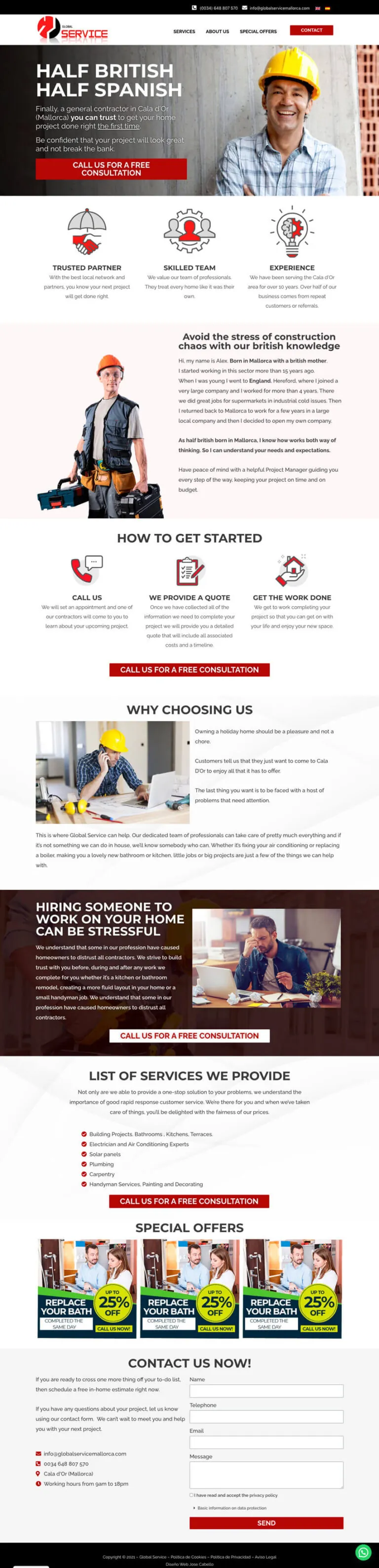
- A headline that answers their fear: “Half British, half Spanish”. The founder was born in Mallorca to a British mother and worked in England. Clients immediately understand they’ll be able to communicate with him.
- It names the problem directly: hiring someone to work on your home can be stressful, and the website explains how they avoid that.
- Three clear steps: you call, they visit and give you a detailed quote with costs and a timeline, and they do the work.
- A single action: book a free consultation, repeated throughout the page.
- Concrete proof: more than 10 years working in the area and over half the business from repeat clients or referrals.
It doesn’t try to look like a big construction firm. It speaks to a specific client about what worries them. That’s what makes a renovation website bring in calls. If your clients speak other languages, read how to build a multilingual website properly
Quick website review
- Is it clear in five seconds what you do and where?
- Is there a visible quote button on mobile?
- Do your main services have their own page?
- Do you show real projects with your own photos?
- Does the form ask what you need to assess the job?
- Are there reviews or testimonials with names?
- Is it clear who’s behind the company?
- Do you give any price guidance?
If several points fail, this may help: why your website isn’t getting clients and how to fix it
Frequently asked questions about renovation company websites
Isn’t Instagram or my Google profile enough?
They help a lot, especially your Google profile, but they don’t replace a website: that’s where you explain your services, show your projects in detail and receive quote requests with the information you need.
How much does a renovation company website cost?
It depends on how many services and projects you want to show and whether copy is included. A simple one-page website might cost around €300–€900 and a multi-page business website from €800 upwards. See prices by type in how much a website costs
Do I have to show prices on my website?
It’s not compulsory, but giving some guidance (a “from” price or ranges by type of work) encourages the clients who are a good fit to get in touch.
Can I use photos from the internet if I don’t have my own yet?
Not to show your work: if a client finds out the projects aren’t yours, you lose their trust. Use your own photos, even if there are only a few, and add each new project.
Is it worth advertising on Google?
For services such as bathroom or kitchen renovations it can work, as long as ads lead to a specific service page. You’ll find how to start in Google Ads for small businesses
If you’d like me to take care of your company’s website
I design and write websites for service businesses, including renovation and building companies. The Small Business Web Package (€699 + VAT) is a one-page website to get started; custom design, with several service pages and your projects, starts at €1,995 + VAT.
Tell me what you need